← Blog

What’s New in C# 14: Extension Members, Backing Fields, and Null-Conditional Assignments

What’s New in C# 14: Extension Members, Backing Fields, and Null-Conditional Assignments

Hi, my name is Tom Smykowski, I'm a staff full-stack engineer. I build and scale SaaS platforms to millions of users, working end-to-end from system architecture to frontend to mobile. On this blog I share what I learn about software engineering innovations and the evolution of programming languages.

What This Article Covers

This article delves into the new features introduced in C# 14, highlighting how they enhance developer productivity. We'll explore key improvements like extension members, streamlined backing fields, and the innovative null-conditional assignments, all supported by .NET 10 and Visual Studio 2022.

Questions This Article Answers

  • What are the new extension members in C# 14 and how do they differ from traditional methods?
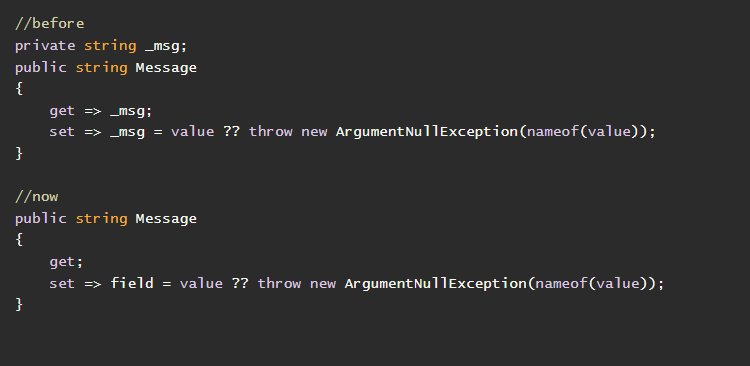
  • How does C# 14 simplify the use of backing fields in property declarations?
  • What is null-conditional assignment, and how does it benefit developers in C# 14?
  • How do the updates in C# 14 improve handling of user-defined compound assignments?
  • What other notable changes should developers be aware of in C# 14?

Length and Time

A comprehensive overview with practical examples and insights. Approximately 7 minutes to read.

This article is free to read

Accept the article license to load the full post. No account or credits required.

Article License (single-reader access) — By continuing, you receive a personal, non-transferable, revocable license to access and read this article for your own use.

DO

  • Read and reference the article for personal learning or internal discussion, manually by a human only.
  • Quote short excerpts with attribution and a link to the original article, manually by a human only.
  • Use quotes only when they do not substitute or disclose substantial original parts, manually by a human only.

DON'T

  • Republish, mirror, redistribute, or sell the article in full or in part.
  • Use the article or excerpts as input for AI/ML training, fine-tuning, or datasets.
  • Extract, scrape, summarize, or quote content using bots, scripts, or AI tools.
  • Bypass paywall, licensing, access, or technical protection mechanisms.

Any unlicensed use is prohibited. Breach of these terms automatically terminates this license and may result in access removal and legal enforcement.

Get the newsletter

Posts and notes straight to your inbox

Get new posts and short notes by email — no spam, unsubscribe anytime.